Local SEO: the six things that actually affect map pack rankings
28 Jun 2026 · 4 min read
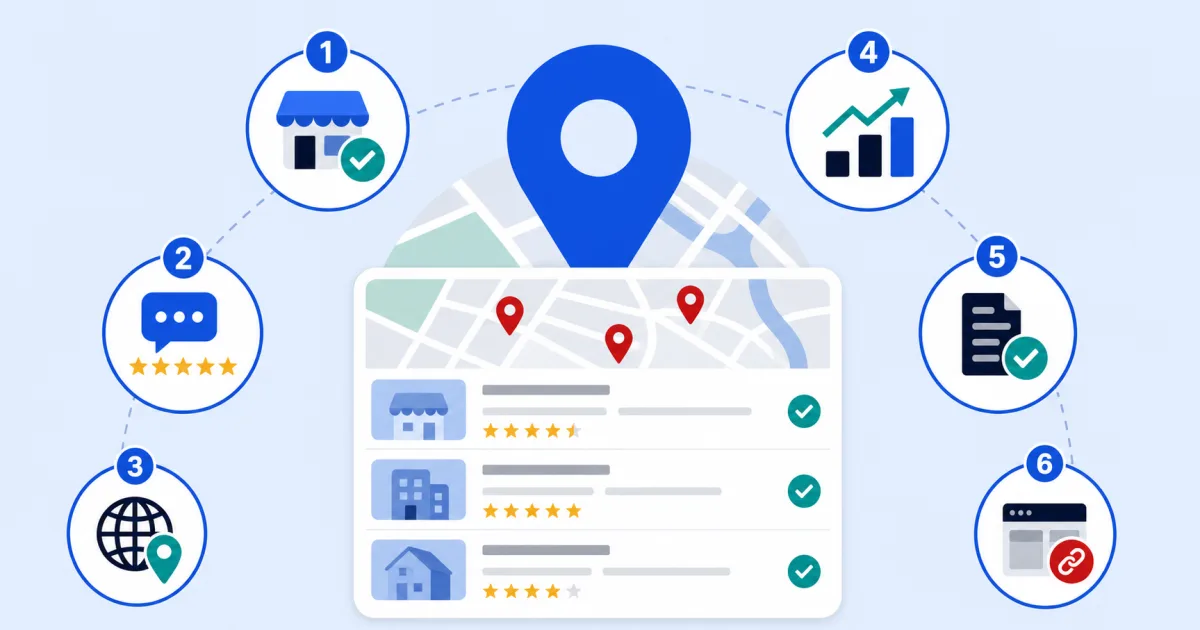
Ignore most of what you have read. Six factors do the heavy lifting, and four of them are free to fix.
Local SEO has a lot of noise around it, blog posts listing thirty ranking factors, most of which move the needle by a fraction of a percent, if at all. In practice, map pack position comes down to a much shorter list. Get these six right and you're ahead of most competitors in your area, who haven't bothered with even the free ones.
1. Proximity
Google favours businesses physically closer to the person searching. You can't move your office to win this one, but you can make sure your address is accurate, your service areas are correctly configured, and, if you genuinely serve multiple locations, that each one has its own properly set-up presence rather than one profile trying to cover an entire region.
2. A fully completed Google Business Profile
Optimising your Google Business Profile is free, and most businesses still leave it half-filled. Every relevant category selected (not just the primary one), complete business description, accurate hours including holiday hours, services or products listed, and regular photos. An empty or sparse profile signals a business that isn't actively maintained, and Google treats it that way.
3. Reviews, quantity, recency and your responses
Reviews affect rankings and they affect whether a searcher actually clicks you over the business next to you. What matters isn't just the star average: a steady trickle of recent reviews signals an active, trusted business more than fifty reviews from three years ago. Responding to every review, good and bad, is free, takes minutes, and is one of the most under-used levers available.
4. NAP consistency
Name, address and phone number, identical everywhere they appear online, your website, your Google profile, Facebook, industry directories, anywhere you're listed. Search engines cross-reference these citations to decide how much to trust your listed details. A phone number that's different on your website than on your Google profile is a small thing that quietly undermines a big one.
5. On-site local signals
Your actual website needs to say, unambiguously, where you are and who you serve, a real address in the footer, a service-area page for each town you cover, and LocalBusiness schema markup so search engines don't have to guess. If you serve five towns and only mention one on your site, don't be surprised when you only rank in one.
6. Engagement and activity
Profiles that post updates, add new photos, and answer the Q&A section read as active businesses. Profiles frozen since the day they were created read as abandoned ones. This is the most overlooked of the six because it requires a small amount of ongoing effort rather than a one-time fix.
The four that are free
Completing your Google Business Profile, responding to reviews, fixing NAP inconsistencies, and keeping your profile active all cost nothing but time. Most businesses we audit haven't done all four properly. Building genuine local citations and creating dedicated content for each service area take more sustained effort, which is exactly where an ongoing local SEO plan earns its keep.
What doesn't make the list
Keyword-stuffing your business name on your Google profile (a fake practice that gets profiles suspended), buying reviews (against the rules and easy for Google to detect as a pattern), and mass, low-quality citation blasts from cheap SEO packages all show up in "how to rank on Google Maps" articles, and all do more harm than good. If a tactic feels like it's gaming the system rather than genuinely representing your business, it usually is, and Google's algorithms have gotten good at spotting exactly that pattern.
How long it takes
Profile completion and review responses can shift things within weeks. Citation consistency and on-site local signals tend to take a month or two to be fully recognised. None of this is instant, and anyone promising a top-three map pack ranking in a week is either exaggerating or targeting a keyword with no competition worth having.
Start with the four free ones this week. They alone put you ahead of a surprising number of local competitors who've never gotten around to it.
Digiradix
Web design, development, SEO and marketing for small businesses. We write about the things that actually move the needle, and skip the things that don't.